Hi, I’m Liat Berdugo. I’m a multidisciplinary artist and writer based in Oakland, CA.
My work investigates the relationship between technology, visuality, politics, and power. Power is a big word, so I anchor it in specifics: labor and capital, militarization, settler-colonialialism, and technological utopianism. Lately, my work has focused on computational art making using image archives and the greenwashing of Palestinian land dispossession.
My work has been exhibited widely in venues such as Yerba Buena Center for the Arts, MoMA PS1, The Luminary, Transmediale in Berlin, V2_ Lab for the Unstable Media in Rotterdam, Gallery Bomba in Moscow, West Space in Melbourne, and the 3rd, 5th, and 7th editions of The Wrong Biennale. My writing appears in Rhizome, Places, Leonardo, The Architectural Review, Millennium Film Journal, The Institute for Network Cultures, and various academic and open access presses; and my book, The Weaponized Camera in the Middle East, was published by Bloomsbury/I.B.Tauris in 2021.
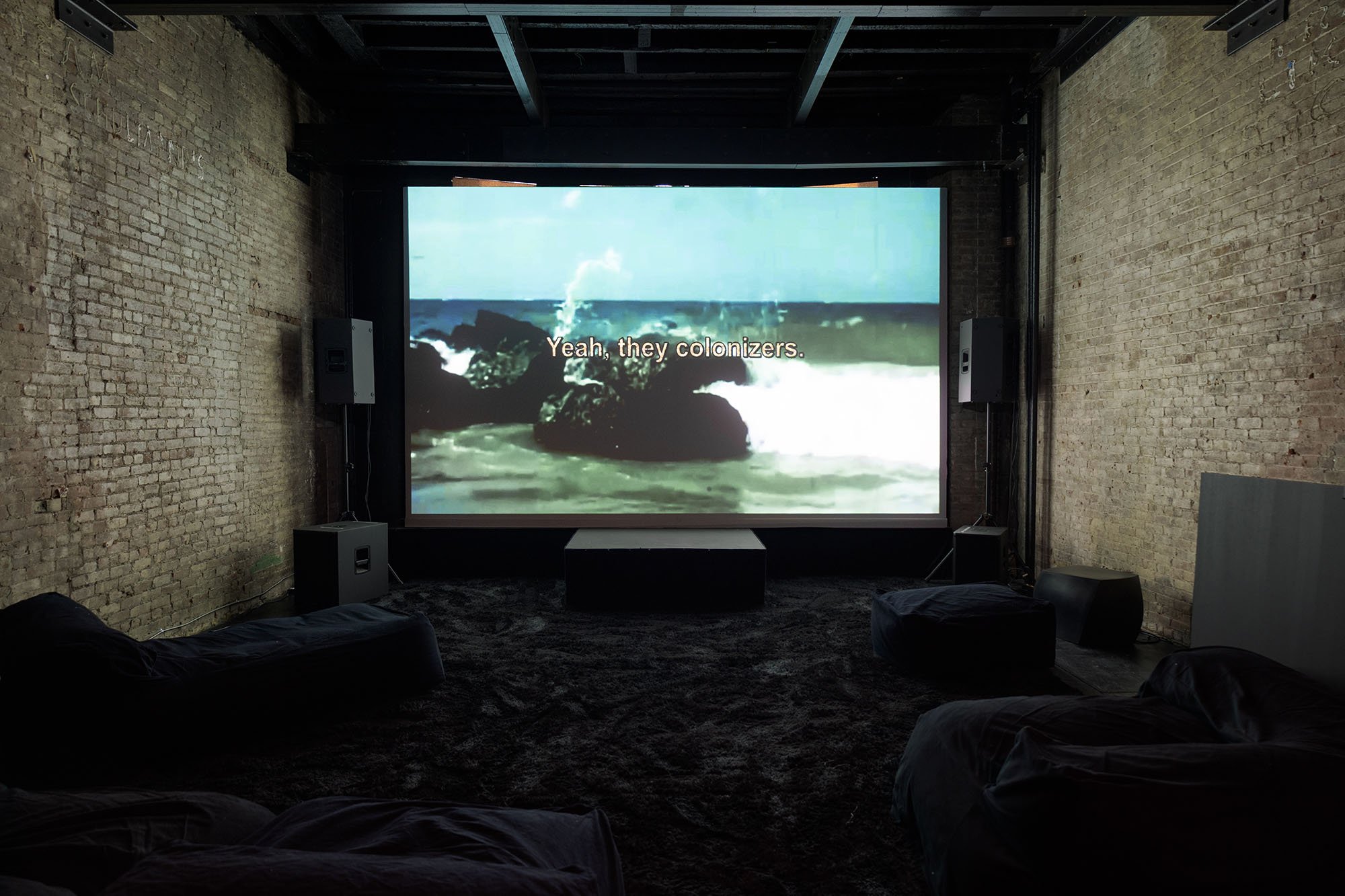
The Insufferable Whiteness of Being in the exhibition "Mad World 2026: A Bag to Breathe Into" at SoMad, New York, 2026. Photo: Marissa Alper.
Central to my practice is the assertion that art can employ common and pedestrian forms of technology to critically question, dismantle, and reconceive power structures. I ask, for instance, what AI can take away, rather than generate, when I create a speculative anti-archive using fifty thousand images from the Jewish National Fund to explore the relationships between state power, archives, and the right to representation. I ask how the utopian promises of cryptocurrency can be pushed to absurdist extremes as social commentary on the accelerationist, neoliberal ideologies they incubate. I ask how the ways technology has taught our bodies to move – through the patented, multi-touch gestures we use on iPhones – can be claimed back from large corporations by rogue citizen bodies.
In moving through these inquiries I am also fascinated by interruption. These are again the pedestrian – the physical interruptions of a parent trying to make, the constant pinging of the digital world – and also the violent, even catastrophic interruptions of life and livelihood by a political regime consolidating control. I am drawn to how interruption both forecloses and, paradoxically, opens up new ways of seeing and making.
To explore these questions I work as a multidisciplinary artist. I move through computer programming, bots, photography, video, electronics fabrication, interactive performance, textiles, critical AI, social practice, and artist books to keep pressing from different angles. For me this is a kind of compulsion: to push until something is exhausted. Rather than depleting, this is generative: exhaustion is where hidden assumptions finally surface.
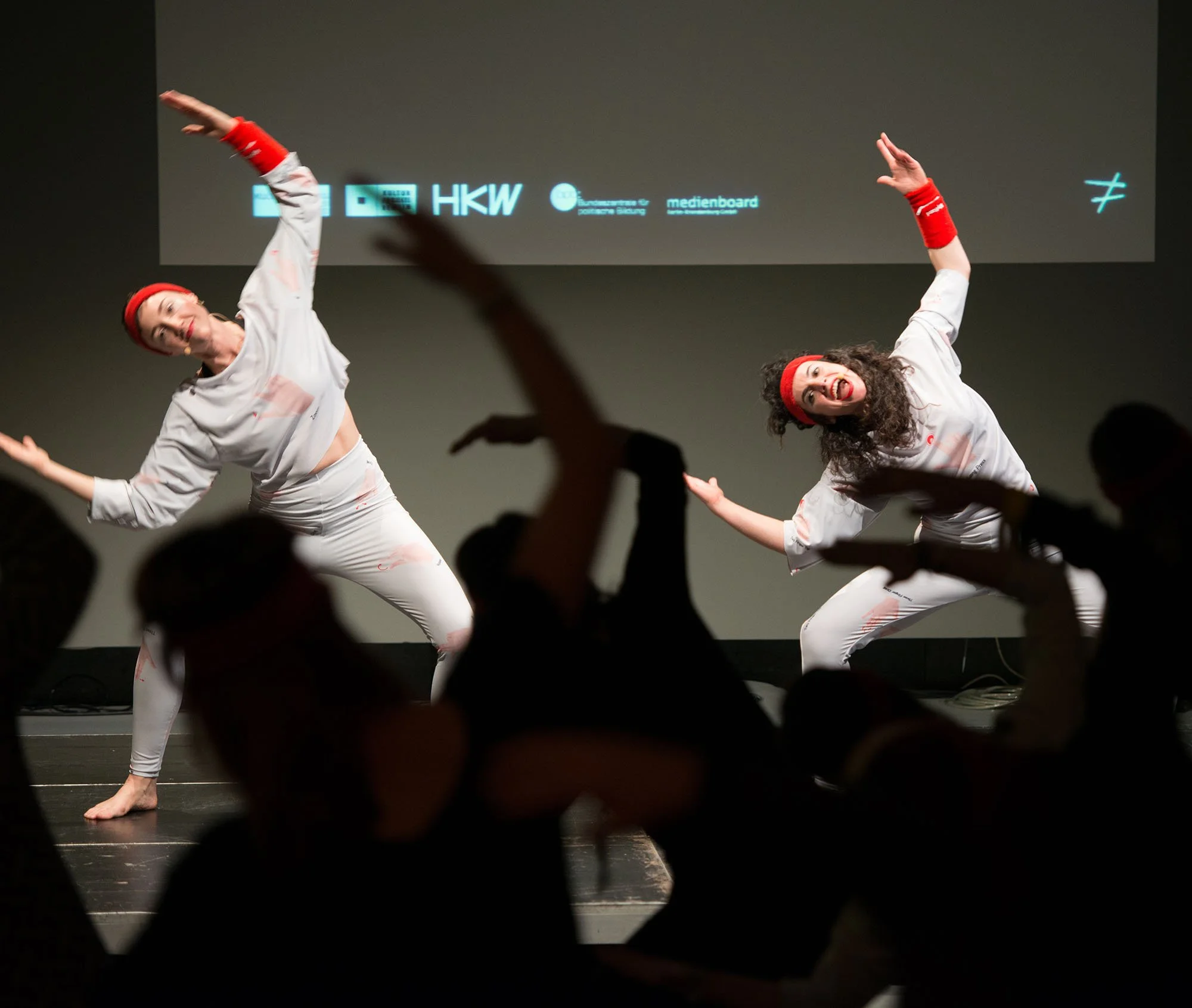
Unpatentable Multitouch Aerobics at Transmediale, Berlin, 2016. Photo credit: transmediale.
Often, my creative practice employs humor or absurdity as an oblique entrance into difficult material. Laughter lets things in. It is a hook into the mind through the visceralities of the body. That's why I return to it so often: once the body is laughing, the mind is already halfway to the harder question.
I frequently work in collaboration with other artists, most notably as Anxious to Make (2015-2020), the two-person art collective comprised of myself and LA-based media artist Emily Martinez. I co-founded the Living Room Light Exchange (LRLX), a monthly new media art series in the San Francisco Bay Area which I co-curated from 2014 until 2021 and which I now advise. LRLX is still running today, and has spawned satellite Exchanges in Brooklyn, Paris, and beyond.
My work rests upon the foundation of my family, my ancestors, and my upbringing. My Jewish American mother was a social worker and my Moroccan-Israeli father worked as an engineer constructing sensors for military aircraft systems -- a trade he learned in the Israeli army. We spent time living in both Philadelphia and Jerusalem, and I was raised learning to straddle two very different languages and cultures. This has translated to my scholarship and creative work, where I am most comfortable when straddling disciplines. I am trained as a mathematician and a digital media artist. Like many artists with technical skills, I supported my artistic practice with a series of odd jobs in the tech industry: I wrote code for biotech research trials and I designed user interfaces for social media games and gig-economy start-ups. In line with my practice of wide cross-pollination, these jobs were not merely compensated time cast-offs; instead my work grows out of these experiences. I work with technology because I am fluent with both its function and the power it holds. My work on Israel and Palestine comes from lived experience and from a family history bound up in Zionism — an inheritance I've chosen to meet with critique.
What follows is a short narrative of my work over the past fifteen years, grouped thematically.
1. Emancipation, Land, and Power
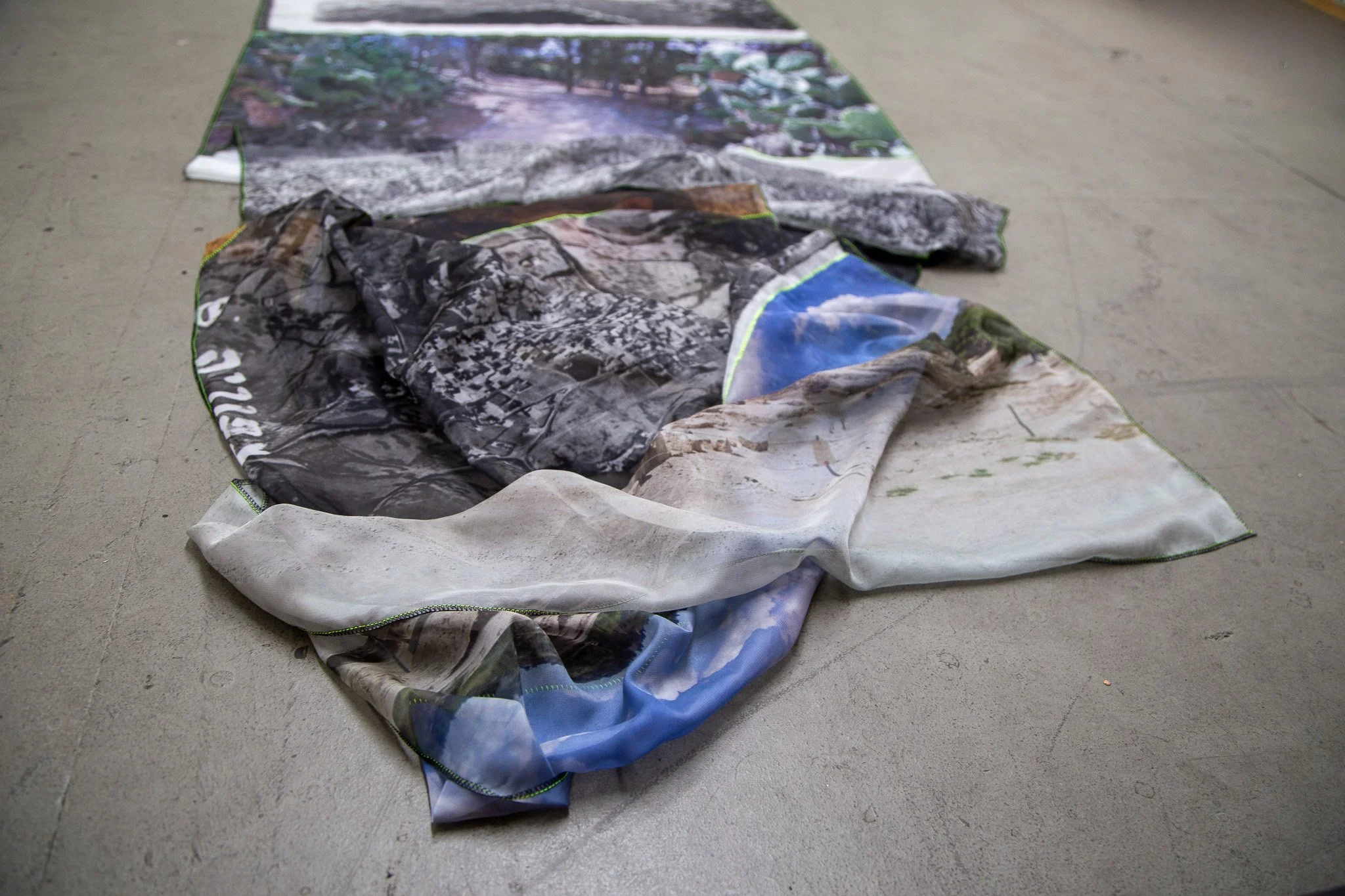
Tsipori over Safuriyya, printed chiffon, thread, 3’ x 28’, 2026
As the most personal work I make, these projects also carry the most generative discomfort. This work takes up state and military power, counter-surveillance, and the visual rights structures of land dispossession. It is concerned most directly with Israel and Palestine, though several works extend the same questions to U.S. political life.
My book, The Weaponized Camera in the Middle East (2021, Bloomsbury/I.B. Tauris), draws on the video archive of B'Tselem — the Israeli human rights organization that distributes cameras to Palestinians living in the West Bank, East Jerusalem, and Gaza — to make a visual studies inquiry into videographic evidence in Israel/Palestine. Drawing on over 5,000 hours of footage, the book traces an inequality of visual rights: Palestinians first filmed to "shoot back" against an occupying force armed with both weapons and its own surveillance apparatus, and Israeli private citizens then began filming back, creating a simultaneous, echoing counter-surveillance. Ultimately I argue that seeing is not enough – seeing is not believing – because our beliefs about an image alter what we see in the first place.

The Weaponized Camera in the Middle East: Videography, Aesthetics, and Politics in Israel and Palestine published by Bloomsbury/I.B. Tauris in 2021.
For my next project I turned toward my personal entanglements with Israel/Palestine. When I was six years old, I planted a pine tree in the Jerusalem Forest with an organization called the Jewish National Fund (JNF). Though I didn’t know it at the time, many JNF forests are located on the ruins of former Palestinian villages, and the fund has publicly framed strategic forest planting as a way of obscuring traces of Palestinian life from the Jewish Israeli eye. I wrote about this in an essay, A Situation: A Tree in Palestine (Places Journal, 2020), which reckons with complicity, family, and afforestation and sets the terms for the two projects that follow.
Seeing it for the Trees (2023) — a performative lecture, artist book, single-channel video, and custom wallpaper — extends that inquiry into the Jewish National Fund's afforestation campaigns as ecological cover for land dispossession. Central to the project is a bot I coded to scrape the JNF's 50,000+ image archive and text me one photograph an hour for several years, mirroring the archive's own pulse of territorial control. I am currently extending the project with a new bot that prints one image from the archive each day, developed during an artist residency at Writing Space.

Video still from Seeing it for the Trees, 2023.
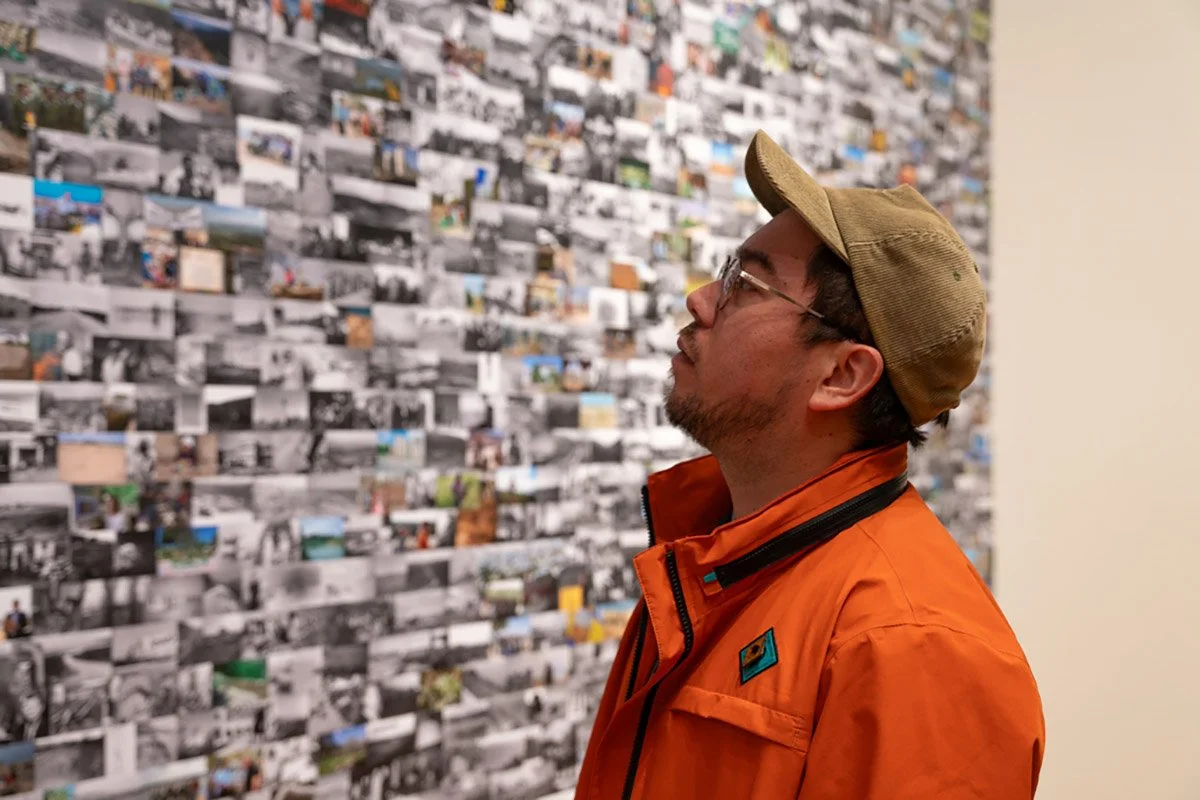
Seeing it for the Trees wallpaper installed at Mills College Art Museum, Oakland, CA, 2023.
The Unsettled Archive (2026) continues this work through a series of large-format chiffon banners — including Tsipori over Safuriyya and Castel over al-Qastal — built from JNF photographs of sites where forests were planted over “depopulated” Palestinian villages. Using generative AI, I remove the human figures from these photographs, leaving only spectral traces: landscapes conjured as they might have remained, absent occupation. During a 2026 artist residency at Squeaky Wheel Film & Media Art Center, I will expand this into a speculative anti-archive using over 50,000 JNF images, exploring the relationships between state power, archives, and the right to representation.
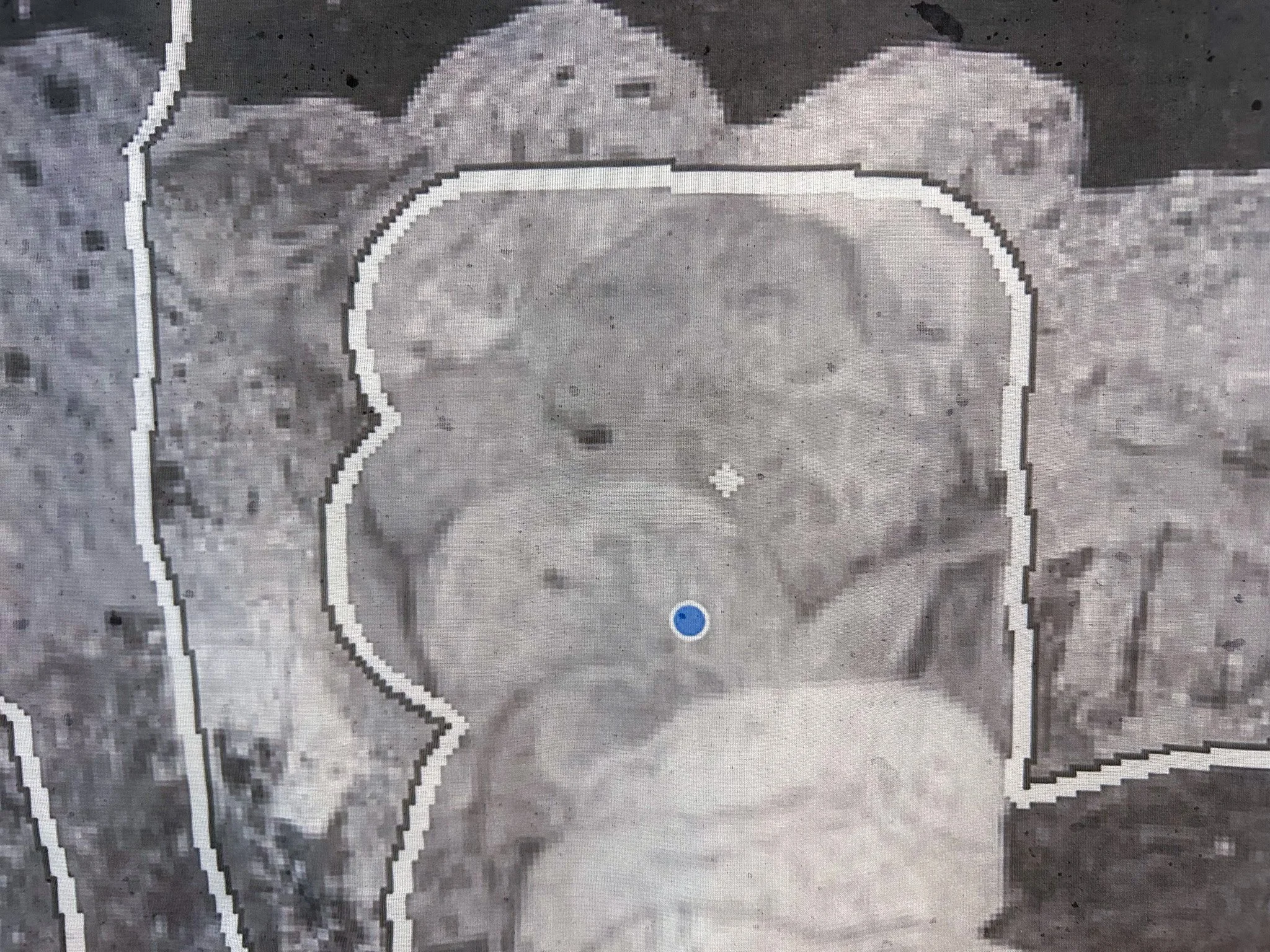
Detail from The Removals (part of The Unsettled Archive) installed in “Flow State” at the David Brower Center, Berkeley, CA, 2026.
Other works turn this same lens on power closer to home: Military Powerpoint Karaoke (2018, with Charlie Macquarie) invited audiences to perform, unrehearsed, from 57,000 publicly available U.S. military PowerPoint presentations; Anti-Trump Aerobics (2017, with Margaret McCarthy) turned political resistance into a 40-minute aerobics class; and Freedom Instruments Toolkit (2017, with Kelly Gregory and Brett Snyder) used a custom deck of cards to ask whether and how freedom can be designed at all.

American technology pioneer Ted Nelson performs a PowerPoint deck titled “Modeling Deceptions in Computer Simulations” from the U.S. Army Research Laboratory at Military Powerpoint Karaoke, Internet Archive, San Francisco, CA, 2018.
2. Labor, Capital, and Care
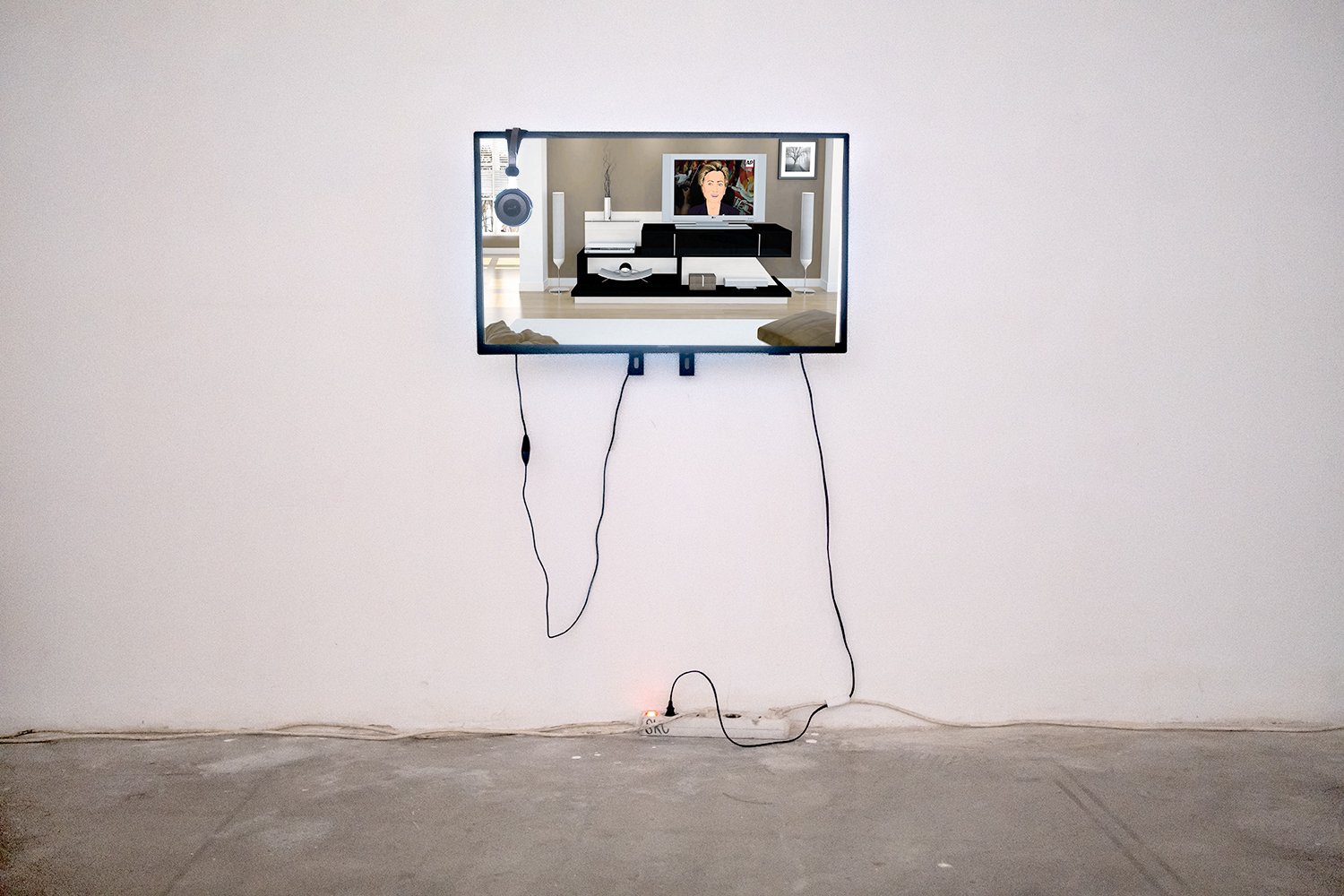
Work Work Work installed in “Démodé” at SKC Gallery in Rijeka, Croatia, 2023.
This body of work traces how technology reorganizes labor, value, and care. I examine platform precarity, financialization, the outsourcing of creative work to gig platforms and AI, and the particular interruptions of parenthood to creatively and critically probe the shifting weight capitalism’s value proposition assigns to these realms.
My long-running collaboration with Emily Martinez as Anxious to Make (2015–2020) grew out of a meta-project: How to Make Yourself into a Commissioning Body in 5 Easy Steps (2016), an algorithm for outsourcing artists' common anxieties (creative blocks, disillusionment, audience alienation – anxieties Emily and I shared ourselves) to the so-called sharing economy. We then used that system to generate our own projects. Liat Berdugo + Emily Martinez as Five Twins (2016) commissions fake twins from Fiverr.com — single people who pose as twins by doubling themselves in post-production to get more gigs. Performative Validations (2016) commissioned Fiverr spokespeople to perform scripts addressing artists' existential anxieties, and our Generators (2016) are a suite of custom coded web tools for generating project ideas, branding, and motivation, such as a the Confidence Generator, the Tough Love Generator, and the Brand Generator. Work Work Work (2016), built entirely from stock footage and outsourced performances, traces the commodification of creativity under networked capitalism. We then turned to crypto's utopian promises: Bitcoin Futures (2018) is a functional ATM dispensing crypto-prophecies instead of currency; Seeing Blocks and Crypto Bros (2018) crowdsourced sixty Mechanical Turk workers' drawings of blockchains and Bitcoin owners; and The Insufferable Whiteness of Being (2018) situates Puerto Rico's crypto-utopian colonizers within a longer history of island exploitation.
Prompted Dramas (2023–25) is a series of three videos — Through the Gallery, Shattered Reflections, and The Exhibit You Can't Touch — in which I ask ChatGPT to write short plays for the specific art contexts in which the videos will be exhibited. Each drama unfolds inside the art institution, often naming a very real but taboo threat: a campus gallery facing censorship by a dean, a college museum gutted by a corporate acquisition. Rather than concealing the machine's involvement, the videos make it the subject by transparently playing the interface on the screen. All characters are performed by animated cats as a nod to felines’ status as the original meme keepers of the internet. Written across ChatGPT's rapid evolution from 2023 to 2025, the scripts also chart the chatbot's own drift — its biases about art, race, privilege, and education, its compulsion toward tidy endings, and its increasingly relentless eagerness to help — so that, taken together, the three videos double as an inadvertent self-portrait of the model itself.
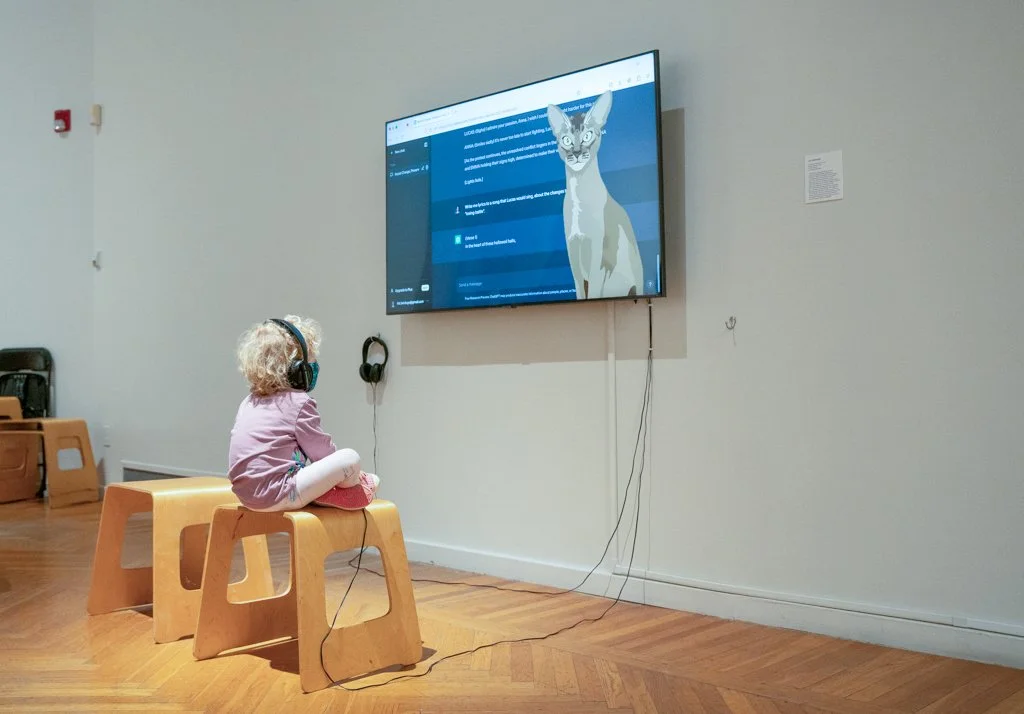
Shattered Reflections installed at Mills College Art Museum, Oakland, CA, 2023.
Questions of labor also led me to make work about the intimate labor of childbirthing and parenting. Becoming a parent transformed my process: concentrated studio time gave way to fragmented pockets of time. The Motherhood Art Assignment Generator (2024) responds directly to that shift — an algorithm I coded that generates some 100,000 art assignments about motherhood by permutation, embodied in two tactile objects: an oversized plush dice set (one die offering a medium, the other a subject drawn from lived parenthood) and a text-covered shower curtain, the shower being one of the few places a mother might find herself briefly, blissfully alone. Together, the objects are one part provocation, one part inspiration, and one part artwork in their own right.
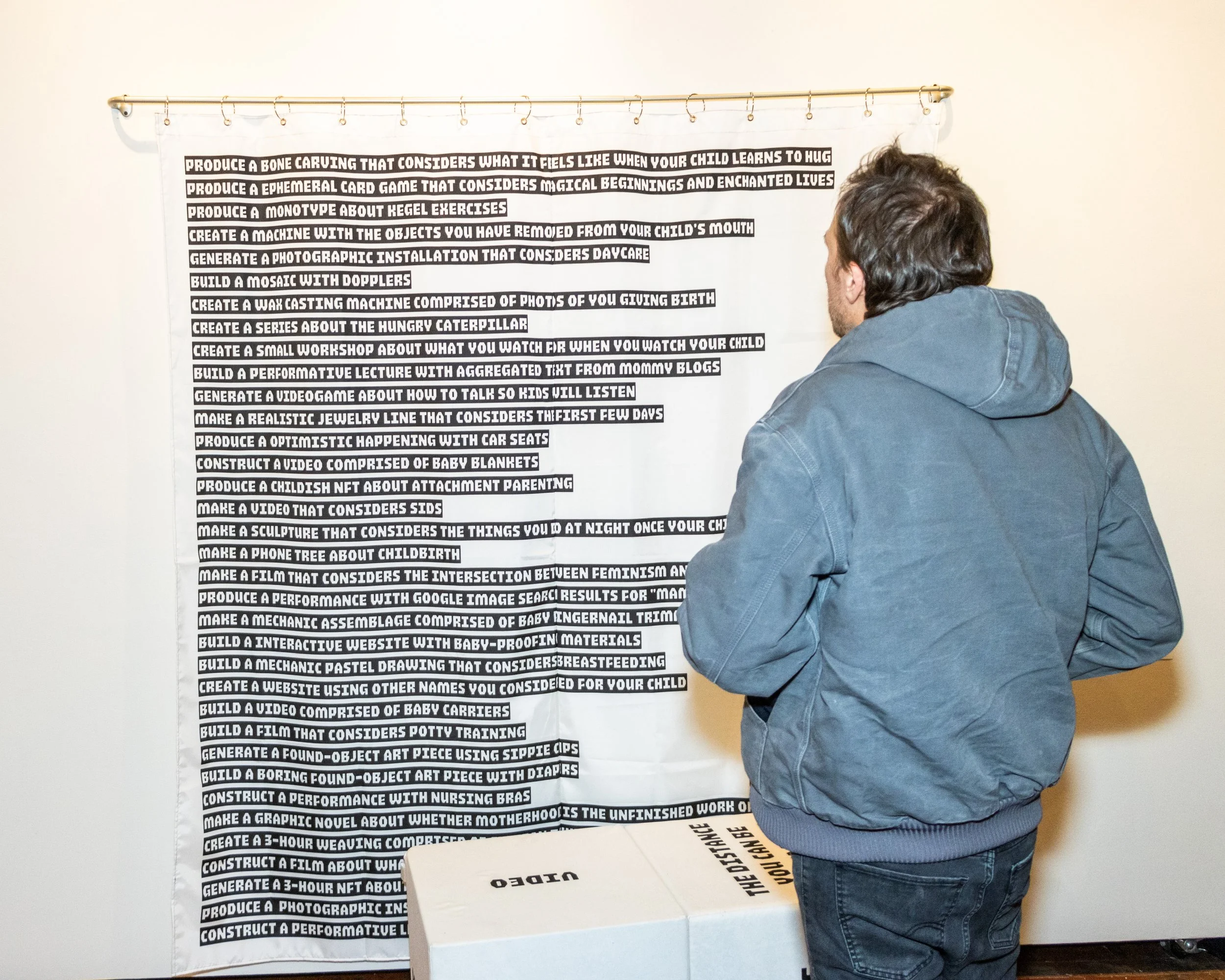
Motherhood Art Assignment Generator installed in Root Division Gallery, San Francisco, CA, 2024.
3. Embodiment + Interfaces
The body itself is also an interface, and these works test the patented gestures technology has taught us, and physicalize the abstractions of software and networked life.
I've long been interested in Apple’s patents on the pinch-to-zoom gesture, since Apple is "indisputably striving to corner the market on how we move our fingers across screens," as critic Alexander Provan put it. If Apple was going to own that patent, I wanted to own the copyright on the "dance" of zooming myself into a camera. The Zoom Series (2012–13) is the result: video works where I restage Apple’s patented gestures — the pinch-to-zoom, the two-finger scroll – for the camera alone, with no device visible. I filed for a US copyright on the choreography of zooming myself into the camera, since works of choreography are copyrightable under US law. The Copyright Office denied my filing, ruling that what I'd submitted was not a choreography but "an aerobic exercise program."
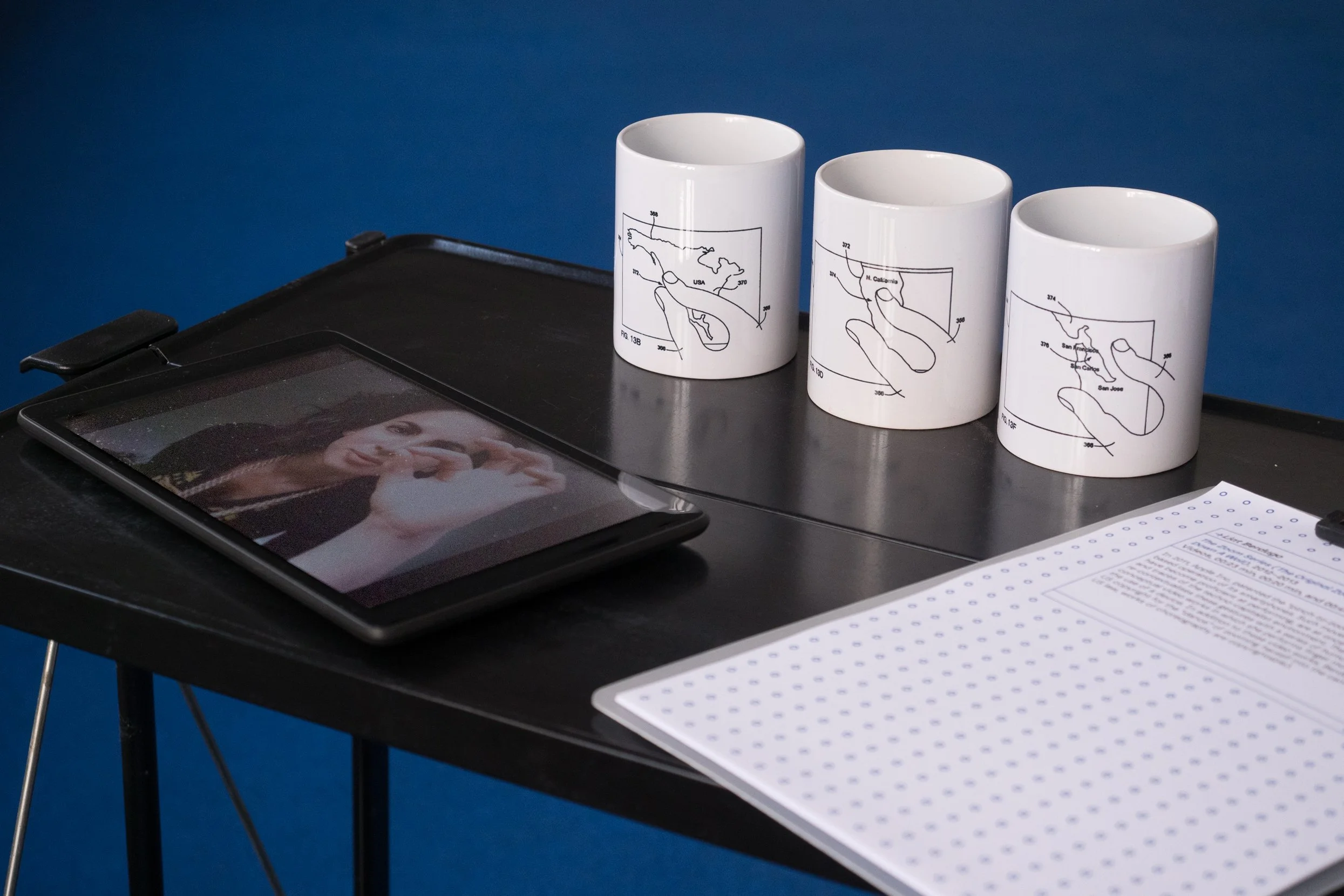
The Zoom Series, in the exhibition “Out of Office” at Medienwerkstatt Wien, Vienna, 2023. Photos: Miae Son.
Taking the government abstracted logic of bifurcation further, I produced, Unpatentable Multitouch Aerobics (2015–16, with dancer Phoebus Osborne). The performance is a 40-minute aerobics routine built from the same multi-touch gestures — pinching, scrolling, rotating — that Apple has patented. It asks us to consider what it means that our own hands, in motion, are already leased from a corporation. It has since been re-performed, "sonified" into a music score, and screened internationally, from Transmediale in Berlin to Düsseldorf's Digital Art Festival.
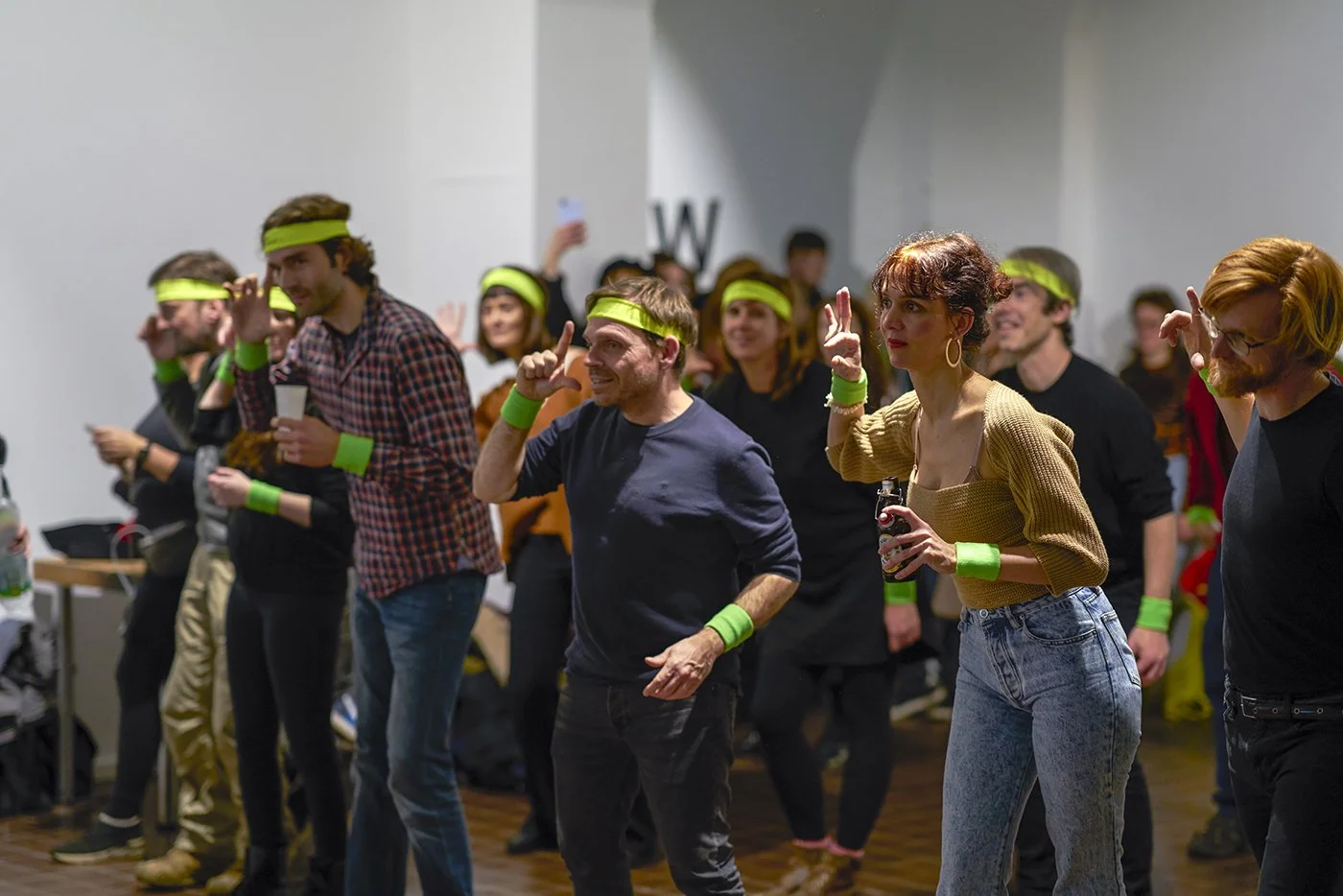
Unpatentable Multitouch Aerobics at Digital Art Festival Die Digitale in Düsseldorf, Germany, 2019.
Sweat Net (2017), commissioned by the Center for Contemporary Art in Tel Aviv, required museum visitors to shake their phones vigorously before being granted wifi access — a humorous but pointed choreography of the body's labor in service of connectivity. The performative-lecture strand of Seeing it for the Trees (2023) extends this embodied approach into the archive itself, using live code to text archival images directly to audience members, rather than projecting them onto a screen, making their phones the site of constant, private pinging and viewing.

Sweat Net at the Center for Contemporary Art, Tel Aviv, Israel, 2017.
This interest in the body's encounter with technology goes back even further in my creative work. My iPhone is Everything (2012) recasts iPhones and iPads as objects they could never truly be — weights, oven mitts, a cheese grater — asking what a world would look like if we pushed technology's do-anything promises to their absolute extremes. Switch (2011) works the same angle from the other direction: 20 videos of ordinary electrical objects operated by tangible, makeshift interfaces, all of it faked. Switch is magic in its truest sense: an illusion, existing in the gap a viewer's own projection of technological fantasy fills in.

Video still from My iPhone is Everything, v. 14, 2012.
4. Community + Curation
Alongside my studio practice, I build community around other artists' work. My curatorial practice is an extension of the same questions I ask in the studio: what forms of gathering, dialogue, and mentorship can hold difficult or emergent work well?
I co-founded the Living Room Light Exchange (LRLX) with Elia Vargas in 2014 and co-curated it through 2021, mentoring the new curators I passed it on to and remaining an informal advisor ever since. LRLX has held more than fifty monthly salons in rotating Bay Area living rooms, featuring over 150 artists, cultural producers, and scholars working at the intersection of art and technology. It is deliberately located in the intimacy of domestic space as a counterweight to the more superficial "techno-fetishism" of the region that surrounds it. It spawned satellite Living Room Light Exchanges in New York, Paris, Tel Aviv, and Birmingham (UK).

Chris Sollars speaks at the Living Room Light Exchange (LRLX), San Francisco, CA, 2015.
I also co-founded World Wide West (2015–2017) with Sam Kronick, Ben Lotan, and Tara Shi, an annual festival of new media art and digital culture, held on a rural property in Point Arena, CA. My own collaborative contributions to the summit include Field Link (2015) – the performative burial of a 350-meter fiber-optic cable to create the first-ever citizen-laid internet connection, in a field just miles from where transpacific cables actually land at the Manchester Cable Landing Station – and Encoded Forest (2016), a land art piece that encodes the site’s wifi password into “tree binary,” trees standing for 1s, gaps for 0s, through the planting of 128 redwood trees in a large grid for future wifi-seekers to decode.

Installing Field Link in Point Area, CA, 2015.
In Israel/Palestine, I served as video art, net art, and special programs curator (2014–2016) for Print Screen, the region's international festival of digital art, where I curated a net art exhibition titled #relaxationmachine and organized "The Internet Bedroom," a 24-hour sleepover conducted entirely over the internet by participants from around the world.
More recently I’ve also focused on helping my fellow academics as director of the Articles track of the Design Writing Fellowship (2022-present), a program that helps design faculty and researchers turn their writing into publishable work. This past year, I revamped the Articles track to focus specifically on teaching design professors to write academic articles about their own pedagogy.
I have been a full-time professor of Art + Architecture at the University of San Francisco since 2015, where I've worked with and mentored hundreds of students, directed the Design Program, and launched, as the inaugural director, a new undergraduate program in User Experience / User Interface (UX/UI) design. Together with my students, I work to form considered and deliberate communities in my classrooms, bolstering my students’ own creative and critical capacities as we all careen together into the ever changing, increasingly technological, and unknown future.

Video still from Liat Berdugo + Emily Martinez as Five Twins, 2016.